---
title: The impact of color crosstalk in different color imaging acquisition methods in machine vision
description: The impact of color crosstalk in different color imaging acquisition methods in machine vision
image: https://news.jai.com/hubfs/Blog-News%20images/Blog-Articles-Body-Text-Images/Prism-Bayer-cross-talk.png
---
- [Products](https://www.jai.com/products)
- [Applications](https://www.jai.com/markets-applications)
- [Knowledge](https://www.jai.com/technology)
- [Blog](https://news.jai.com/blog)
- [Support & Software](https://www.jai.com/support-software)
- [Company](https://www.jai.com/company)
- [Contact](https://www.jai.com/contact/contact-jai)
[](https://cta-redirect.hubspot.com/cta/redirect/3919337/de912c88-f441-4cc7-a217-0079ed79e720)
Search...
- [](https://www.printfriendly.com)
- [Blog](https://news.jai.com/blog)
- [Support & Software](https://www.jai.com/support-software)
- [Login](https://www.jai.com/login)
- [Language English](https://www.jai.com/)
- [简体中文](https://news.jai.com/cn)
- [한국어](https://news.jai.com/ko)
- [Deutsch](https://news.jai.com/de)
[](https://www.jai.com/)
- [](https://www.jai.com/)
- [Products](https://www.jai.com/products)
- [Applications](https://www.jai.com/markets-applications)
- [Knowledge](https://www.jai.com/technology)
- [Blog](https://news.jai.com/blog)
- [Support & Software](https://www.jai.com/support-software)
- [Company](https://www.jai.com/company)
- [Contact](https://www.jai.com/contact/contact-jai)
- [Blog](https://news.jai.com/blog)
- [Support & Software](https://www.jai.com/support-software)
- [Login](https://www.jai.com/login)
- [Language English](https://www.jai.com/)
- [简体中文](https://news.jai.com/cn)
- [한국어](https://news.jai.com/ko)
- [Deutsch](https://news.jai.com/de)
- [](https://cta-redirect.hubspot.com/cta/redirect/3919337/de912c88-f441-4cc7-a217-0079ed79e720)
- [Home](https://www.jai.com/)
- [JAI Blog](https://news.jai.com/blog)
- The impact of color crosstalk in different color imaging acquisition methods in machine vision
# The impact of color crosstalk in different color imaging acquisition methods in machine vision
By [JAI](https://news.jai.com/blog/author/jai) | April 28, 2026
**Why color imaging technology plays an important role in machine vision**
Color imaging plays an important role in many machine vision applications, enabling systems to detect, classify, and evaluate objects based on their color characteristics. Typical use cases range from food sorting/grading and pharmaceutical inspection to print verification, electronics assembly, and medical imaging. In some of these applications, color is a critical measurement parameter, where even small deviations must be detected reliably. In others, color information is only used for basic differentiation, such as identifying objects or supporting general inspection tasks, where extremely high color precision is not required.
This variation in requirements raises an important question: how accurately is color actually captured by a machine vision camera? The answer depends largely on the underlying imaging technology. Today, most systems rely on either single-sensor CMOS cameras using Bayer mosaic filters or multi-sensor cameras based on prism optics, such as 3-CMOS systems.
Both technologies are capable of producing color images, but they differ fundamentally in how color information is captured and processed. These differences directly affect color accuracy, spatial resolution, and overall inspection reliability. Understanding these differences is therefore essential when selecting the right camera, especially in applications where color is not just a visual attribute, but a measurable and critical parameter.
**The visible spectrum and human color perception**To understand how cameras capture color, it is useful to begin with the nature of visible light itself. The human eye perceives color as part of the visible electromagnetic spectrum, which spans from approx. 450 nm to 700 nm. Within this range, blue light typically occupies wavelengths from around 420 to 495 nm, green from about 500 to 580 nm, and red from approximately 580 to 700 nm. These ranges are not sharply defined, and there are no strict boundaries between colors. Instead, the transitions between colors are gradual, reflecting the continuous nature of the spectrum.
Human vision is based on three types of cone cells in the retina, each sensitive to different portions of the visible spectrum. These cones do not detect single wavelengths but rather respond to overlapping ranges of light. The brain interprets color by combining the signals from these three types of receptors. This principle of combining three overlapping signals to reconstruct color is directly mirrored in digital imaging systems.
Both Bayer and prism-based 3-CMOS camera technologies are designed around this RGB-channel model of color perception. However, they differ significantly in how they capture and process these signals, which ultimately influences how accurately colors are reproduced.
**Capturing color images using Bayer Mosaic imaging technology**In a Bayer-based camera, color information is captured using a single CMOS sensor covered by a color filter array arranged in a mosaic pattern, typically consisting of red, green, and blue filters in an RGGB configuration. Each pixel is assigned to one of these filters, meaning that it primarily detects light within a specific wavelength range corresponding to its color.
It is important to note that these filters are not perfect. A pixel intended to capture green light, for example, does not respond exclusively to green wavelengths, as the filter characteristics also allow a portion of red and blue light to pass through.
Because each pixel only captures (primarily) one color component, no single pixel contains complete RGB information. To create a full-color image, the missing color values in each pixel must be estimated using a process known as demosaicing or color interpolation. In this process, the camera uses information from neighboring pixels to estimate the missing color components for each pixel. Algorithms such as 3×3 or 5×5 interpolation kernels analyze the surrounding pixel values to reconstruct the full RGB signal for each pixel.
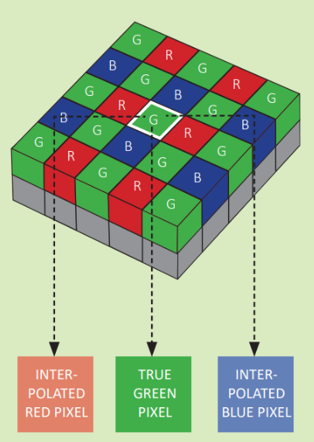
While this approach is efficient and widely used, it has certain limitations. The interpolation process inherently reduces spatial resolution and can introduce artifacts such as false colors or edge distortions. Furthermore, the final color values depend on both measured and estimated data, which can affect accuracy and consistency. As a result, Bayer-based imaging provides a reconstructed representation of colors in a pixel rather than a direct measurement.
**Capturing color images using 3-CMOS Prism-Based imaging technology**
Prism-based 3-CMOS cameras take a fundamentally different approach to color imaging. Instead of using a single sensor with a mosaic of color filters, these systems use a prism assembly with dichroic coatings to split incoming light into separate red, green, and blue wavelength.
The prism works by selectively reflecting and transmitting different wavelength ranges. Blue, green, and red light are separated optically and routed to three pixel-to-pixel aligned sensors. As a result, every pixel location is captured simultaneously in all three color channels.
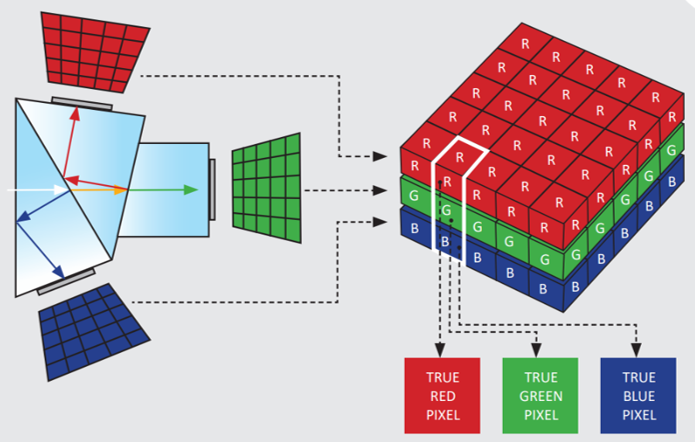
This architecture eliminates the need for color interpolation. Each pixel in the final image represents a direct measurement of red, green, and blue light, rather than a combination of measured and estimated values. The images from the three sensors are then combined to form a final color image with full spatial and color information.
Because no interpolation is required, prism-based systems preserve full spatial resolution and avoid the artifacts associated with demosaicing (color reconstruction). In addition, the absence of color filters at the pixel level allows more light to reach each sensor, improving sensitivity. The result is highly accurate, stable, and detailed color reproduction, making prism-based cameras particularly well suited for demanding imaging tasks.
**Spectral response curves and color crosstalk**
In any color imaging system, each channel (or pixel) measures light over a range of wavelengths defined by its spectral response curve (controlled by pixel or prims filter characteristics). Ideally, each channel would respond only to its intended portion of the spectrum. In practice, however, these curves overlap, leading to so called spectral crosstalk.
In Bayer-based sensors, the spectral response curves are relatively broad and overlapping. This means that each pixel contains a mixture of spectral information. (For example, pixels defined to collect the green wavelength will also contain portions of blue and red wavelength).
However, in some modern Bayer CMOS sensor designs, this overlap can be quite large, leading to inaccurate RGB color reproduction in each pixel as different spectral compositions of light can produce similar RGB values, making it more difficult to distinguish between subtle color differences.
In contrast, prism-based 3-CMOS cameras use dichroic filters with much steeper spectral transitions. These filters provide a clearer separation between red, green, and blue wavelengths, significantly reducing color crosstalk. Each sensor receives a more isolated portion of the light spectrum, resulting in more independent and accurate measurements of the red, green and blue colors.
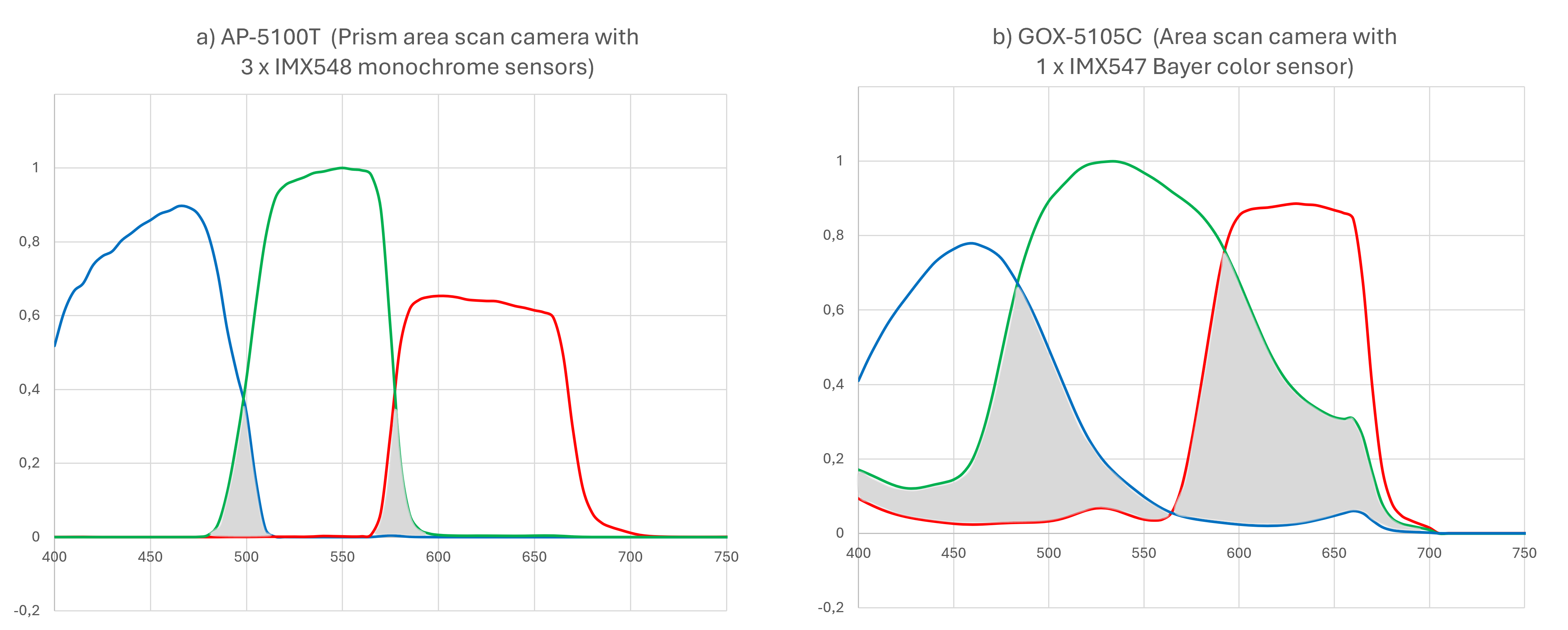
*The grey areas indicate spectral crosstalk between the color channels. In illustration a, the prism-based camera shows steep, well-separated spectral response curves, where each sensor primarily responds within its intended wavelength range with only minimal overlap between the red, green and blue channels.
For example, the blue sensor (represented by the blue curve) primarily receives photons in the blue/deep blue wavelength range (from ~420nm to ~495nm) but also a small portion of green photons (from ~495 to ~500 nm even though at a low response level), while the green sensor receives a small amount of blue photons (~465 to ~500 nm), also at a low response level. This limited overlap reduces crosstalk and yields more accurate color values and better spatial precision.
In contrast, (illustration b) the Bayer camera exhibits broader, less selective spectral response curves, resulting in significantly increased overlap between red, green, and blue channels. For example, the blue pixels respond more strongly to green wavelengths (approximately 495–550 nm), increasing color crosstalk and reducing blue color accuracy, with similar effects observed across the other channels.*
This reduced crosstalk has several important advantages. It improves the system’s ability to distinguish subtle color differences, enhances stability under varying illumination, and reduces the need for complex correction algorithms. Furthermore, because each pixel is measured directly in all three channels, spatial precision is improved, and fine details, especially at edges, are preserved more accurately.
**Bayer vs. Prism: When to use each technology**
The choice between Bayer and prism-based imaging technologies depends on the specific requirements of the application. Bayer cameras are often preferred in situations where cost, compactness, and simplicity are important. They provide sufficient performance for many standard machine vision tasks, particularly when color is not a critical parameter.
In contrast, prism-based 3-CMOS cameras are preferred in applications where color accuracy, stability, and repeatability are essential. Because they provide true per-pixel RGB measurements without interpolation, they offer superior performance in detecting subtle color differences and maintaining consistent results.
There are also cases where a prism-based system may be considered excessive. In applications such as barcode reading, basic object detection, or presence/absence inspection, the additional cost of a prism camera may not provide a meaningful benefit. In these scenarios, a Bayer-based solution is often the more practical choice.
Ultimately, the decision should be based on whether color is simply a supporting feature or a critical measurement parameter in the inspection process.
**Machine vision applications for Prism-Based R-G-B imaging**
Prism-based 3-CMOS cameras offer significant advantages in machine vision applications and are particularly valuable in demanding inspection and sorting tasks such as:
**Food inspection:**
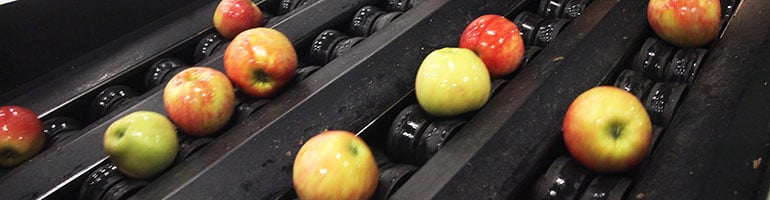
Prism-based separation eliminates color crosstalk, allowing precise grading of subtle ripeness and defect colors in fruits, vegetables, eggs, and meat — even under mixed illumination where Bayer sensors lose contrast.
**Pharmaceutical quality inspection:**
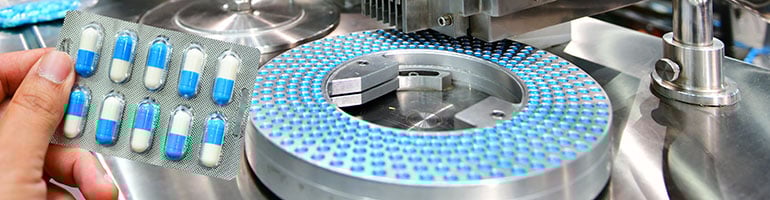
Low crosstalk imaging isolates true color differences in ampoules, capsules, and multi-layer tablets, improving detection of coating variations or contamination where Bayer sensors can be misled by color bleed.
**Electrical component and PCB inspection:**
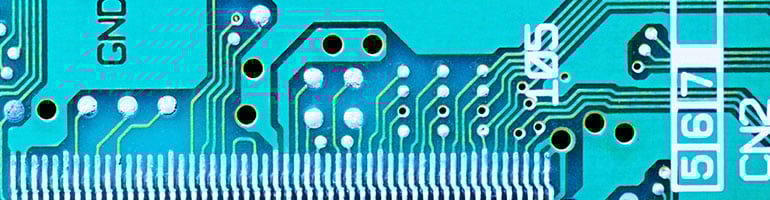
Capture multiple inspection images — such as solder joint integrity, silkscreen alignment, and component presence — in a single pass using different lighting per channel, increasing throughput while reducing camera count and saving system space.
**Automotive inspection:**
By capturing pure R-G-B channels, prism sensors accurately measure paint shades and LED colors without contamination from nearby wavelengths, ensuring reliable results under diverse lighting conditions.

**Concluding remarks**
Bayer mosaic and prism-based imaging technologies represent two fundamentally different approaches to capturing color in machine vision systems. Bayer cameras rely on efficient, single-sensor designs combined with computational reconstruction of color information, offering a cost-effective solution for many applications. Prism-based 3-CMOS cameras, on the other hand, use optical separation to capture true color information directly at each pixel, resulting in higher accuracy and reliability.
While Bayer technology is sufficient for general-purpose imaging, it inherently involves trade-offs in color precision and spatial detail. Prism-based systems eliminate these compromises by providing direct, full-resolution color measurements with minimal crosstalk and no color interpolation.
For applications where color is a critical parameter, this difference can significantly impact inspection performance and reliability. Choosing the appropriate technology is therefore not just a matter of cost, but of ensuring the accuracy and consistency required for the task at hand.
**More information on prism-based cameras for color imaging:**
Overview of JAI 3-CMOS prism-based area scan cameras (Apex Series)
[https://www.jai.com/products/area-scan-cameras/3-sensor-r-g-b-prism/](https://www.jai.com/products/area-scan-cameras/3-sensor-r-g-b-prism/)
Overview of JAI 3-CMOS prism-based line scan cameras (Sweep+ Series)
[https://www.jai.com/products/line-scan-cameras/3-sensor-r-g-b-prism/](https://www.jai.com/products/line-scan-cameras/3-sensor-r-g-b-prism/)
**Prism-based cameras looking beyond the visible spectrum:**
More about prism-based customized multispectral imaging. (Fusion FlexEye Series)
[https://www.jai.com/products/area-scan-cameras/2-sensor-color-nir-prism/](https://www.jai.com/products/area-scan-cameras/2-sensor-color-nir-prism/)
More about prism-based line scan cameras for simultaneous R-G-B-NIR imaging (Sweep+ series)
[https://www.jai.com/products/line-scan-cameras/4-sensor-r-g-b-nir-prism/](https://www.jai.com/products/line-scan-cameras/4-sensor-r-g-b-nir-prism/)
More about prism-based line scan cameras for simultaneous R-G-B-SWIR imaging (Sweep+ series)
[https://www.jai.com/products/line-scan-cameras/4-sensor-r-g-b-swir-prism/](https://www.jai.com/products/line-scan-cameras/4-sensor-r-g-b-swir-prism/)
**Topics:**
- [COLOR IMAGING](https://news.jai.com/blog/tag/color-imaging)
## Related articles
[MULTISPECTRAL IMAGING](https://news.jai.com/blog/tag/multispectral-imaging)
August 26, 2020 | By [JAI](https://news.jai.com/blog/author/jai) | **7 min read**
### Bank note inspection: Show me the money…in color and multispectral!
[Read more](https://news.jai.com/blog/bank-note-inspection-show-me-the-money-in-color-and-multispectral)
[MULTISPECTRAL IMAGING](https://news.jai.com/blog/tag/multispectral-imaging)
March 3, 2020 | By [JAI](https://news.jai.com/blog/author/jai) | **7 min read**
### Prism-based multispectral cameras empower high speed fruit sorting
[Read more](https://news.jai.com/blog/prism-based-multi-spectral-cameras-empower-high-speed-fruit-sorting)
[COLOR IMAGING](https://news.jai.com/blog/tag/color-imaging)
September 18, 2019 | By [JAI](https://news.jai.com/blog/author/jai) | **7 min read**
### Reducing noise in brightfield microscopy images
[Read more](https://news.jai.com/blog/noise-in-brightfield-microscopy)
- [Products](https://www.jai.com/products)
- [Camera Selection Guide](https://www.jai.com/products/camera-selection-guide)
- [Product Series](https://www.jai.com/products/product-lines)
- [Area Scan Cameras](https://www.jai.com/products/area-scan-cameras)
- [Line Scan Cameras](https://www.jai.com/products/line-scan-cameras)
- [Lenses](https://www.jai.com/products/lenses)
- [Software Download](https://www.jai.com/support-software)
- [Traffic Camera & LED Flashes](https://www.jai.com/products/traffic-camera-subsystems-led-flashes)
- [Markets & Applications](https://www.jai.com/markets-applications)
- [Automotive](https://www.jai.com/markets-applications/automotive)
- [Electronics (PCB, Wafer etc.)](https://www.jai.com/markets-applications/electronics-pcb-lcd-wafer-etc)
- [Food and beverage](https://www.jai.com/markets-applications/food-and-beverage)
- [Outdoor and traffic](https://www.jai.com/markets-applications/outdoor-and-traffic)
- [Packaging and print](https://www.jai.com/markets-applications/packaging-and-print-inspection)
- [Pharmaceutical and Cosmetics](https://www.jai.com/markets-applications/pharmaceutical-and-cosmetics)
- [Sports and Entertainment](https://www.jai.com/markets-applications/sports-and-entertainment)
- [Web and Surface Inspection](https://www.jai.com/markets-applications/web-and-surface-inspection)
- [Medical & life sciences](https://www.jai.com/markets-applications/medical-and-life-sciences)
- [Government & defense](https://www.jai.com/markets-applications/aerospace-and-defense)
- [Knowledge](https://www.jai.com/technology)
- [Contact](https://www.jai.com/contact)
- [Contact JAI](https://www.jai.com/contact/contact-jai)
- [Office locations](https://www.jai.com/contact/office-locations)
- [Company](https://www.jai.com/company)
- [About JAI](https://www.jai.com/company/about-jai)
- [News](https://news.jai.com/)
#### Subscribe to our newsletter
Please sign up to JAI´s e-newsletter and get the latest news on products (area scan cameras, line scan cameras and traffic flashes), white papers, technologies and general news. All e-newsletters include an unsubscribe link. You may opt-out at any time. See our [privacy policy](https://www.jai.com/privacy-policy) for further information about processing of your personal data.
- [](https://www.linkedin.com/company/jai-as/)
- [](https://www.youtube.com/user/jaicameras)
- [](https://twitter.com/jaicameras)
- [](https://www.instagram.com/jaicameras/)
- [](https://www.facebook.com/JAI-Cameras-543205976126521/)
- [](https://blog.naver.com/jai-camera)

[](https://www.jai.com/)
- [Privacy policy](https://www.jai.com/privacy-policy)
- [Disclaimer](https://www.jai.com/disclaimer)
 