
High-quality imaging depends on more than just the sensor itself. Temperature also plays a critical role in determining image quality, measurement accuracy, and long-term system stability. This is especially true in short-wave infrared (SWIR) imaging, where thermal noise can have a significant impact on performance.
ThermoElectric Cooling (TEC) is an effective way to manage sensor temperature, helping cameras deliver cleaner images, improved measurement accuracy, and more consistent performance under demanding operating conditions.
What Is Thermoelectric Cooling?
ThermoElectric Cooling (TEC) is a solid-state cooling technology with no moving parts. When electrical power is applied, the TEC module actively transfers heat away from the image sensor, helping to maintain a stable operating temperature.
Unlike conventional cooling methods, a TEC module is mounted directly to the image sensor. Heat removed from the sensor is transferred to a heat sink, where it is often dissipated with the assistance of an integrated fan. By reversing the electrical current, the same TEC module can also heat the sensor when necessary, enabling precise temperature regulation across changing environmental conditions.
This precise temperature control helps maintain consistent imaging performance regardless of ambient conditions.
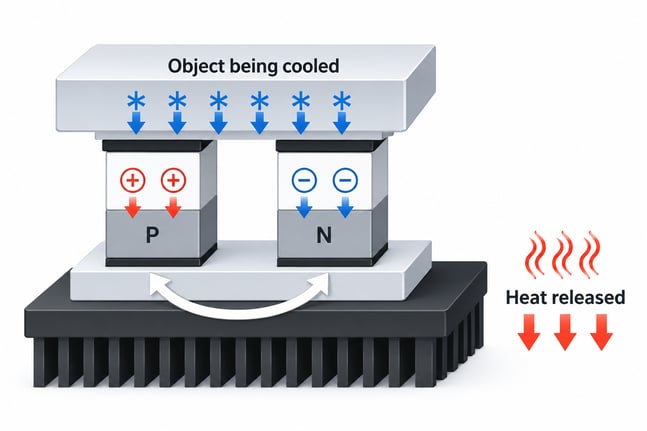 Figure 1. A simplified illustration of how a ThermoElectric Cooling (TEC) module transfers heat away from the image sensor. By lowering sensor temperature by 6-8°C, quantum efficiency (QE) can increase by around 4%, while dark current can be reduced by 50%.
Why Sensor Cooling Is Important for SWIR Cameras
SWIR imaging presents unique challenges compared to imaging in the visible spectrum.
SWIR photons carry less energy than visible-light photons, requiring sensors with a much smaller band gap to detect them. While this enables SWIR imaging, it also makes the sensor more susceptible to thermally generated electrons. These unwanted electrons create dark noise, reducing image quality and measurement accuracy.
As sensor temperature increases, dark noise increases as well. Lowering the sensor temperature significantly reduces this effect. Every 6–8°C reduction in sensor temperature typically reduces dark noise by 50%, making cooling an important factor in achieving high-quality SWIR images.
The Benefits of Thermoelectric Cooling
Actively regulating sensor temperature provides several advantages for SWIR imaging systems:
Reduced Image Noise
Higher temperatures increase dark current, resulting in more image noise. By lowering sensor temperature, TEC significantly improves the signal-to-noise ratio (SNR), producing cleaner, higher-quality images.
Improved Low-Light Performance
Lower dark current allows the sensor to capture weak signals more effectively, improving performance in low-light applications where image quality is particularly sensitive to noise.
Reliable High-Speed Imaging
Improved sensor sensitivity supports reliable imaging at higher acquisition speeds while maintaining image quality, making TEC particularly valuable in demanding industrial inspection applications.
Stable, Repeatable Performance
TEC does more than cool the sensor—it maintains a stable, predefined operating temperature. This helps ensure consistent imaging performance over time, supporting accurate calibration and repeatable measurement results.
Extended Camera Lifetime
Maintaining a stable sensor temperature also helps slow sensor aging, contributing to improved long-term reliability and a longer camera lifespan.
JAI's Cooling Architecture
The JAI WAA-1300-GE-TEC camera has been designed to maximize the benefits of ThermoElectric Cooling through a dedicated cooling architecture.
Heat generated by the image sensor is transferred by the TEC to a heat sink in the center of the camera and dissipated by an integrated fan, helping maintain a low and stable sensor temperature. Other heat generating components such as FPGA and DDR are separated from the sensor at the back of the camera with a dedicated heatsink at the rear where it is dissipated passively through cooling fins and natural airflow.
Separating sensor heat from electronics heat prevents heat recirculation, improves TEC efficiency, and enhances temperature stability, image quality, and overall system reliability.
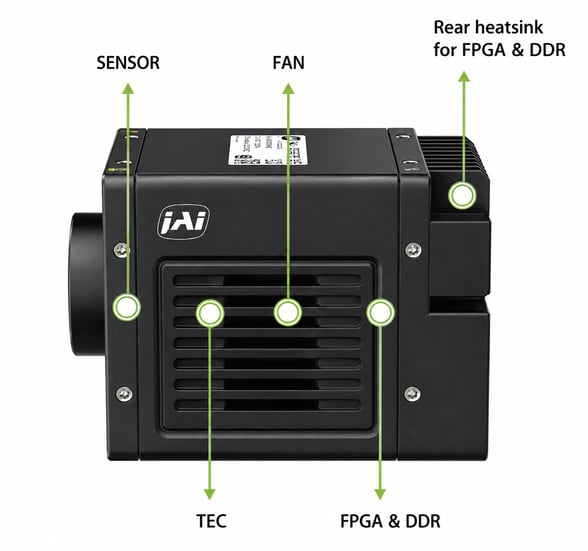 Figure 2. The cooling architecture of the JAI WAA-1300-GE-TEC. The image sensor is actively cooled by the integrated TEC module and fan, while the FPGA and DDR memory are cooled separately through a dedicated rear heatsink. This thermal separation helps maintain a low and stable sensor temperature and consistent imaging performance.
Real-World Performance
The benefits of TEC are clearly demonstrated in JAI's internal testing.
When a threshold was set to evaluate pixel noise, disabling TEC resulted in more than 80 times as many pixels exceeding the defined DN limit compared to when sensor cooling was enabled. This significant reduction in dark-noise pixels with TEC enabled illustrates the impact that effective sensor cooling can have on image quality and reliable inspection performance.
Conclusion
For SWIR imaging, effective sensor cooling is not simply an added feature - it is a key contributor to imaging performance.
By maintaining precise sensor temperature, ThermoElectric Cooling reduces dark noise, improves signal-to-noise ratio, enhances low-light performance, and supports consistent, repeatable imaging over time. Combined with an optimized cooling architecture, TEC enables SWIR cameras to deliver the image quality and reliability required for demanding industrial and scientific applications.
Whether the application involves inspection, measurement, or machine vision, stable sensor temperature helps ensure that the camera performs consistently when image quality matters most.