
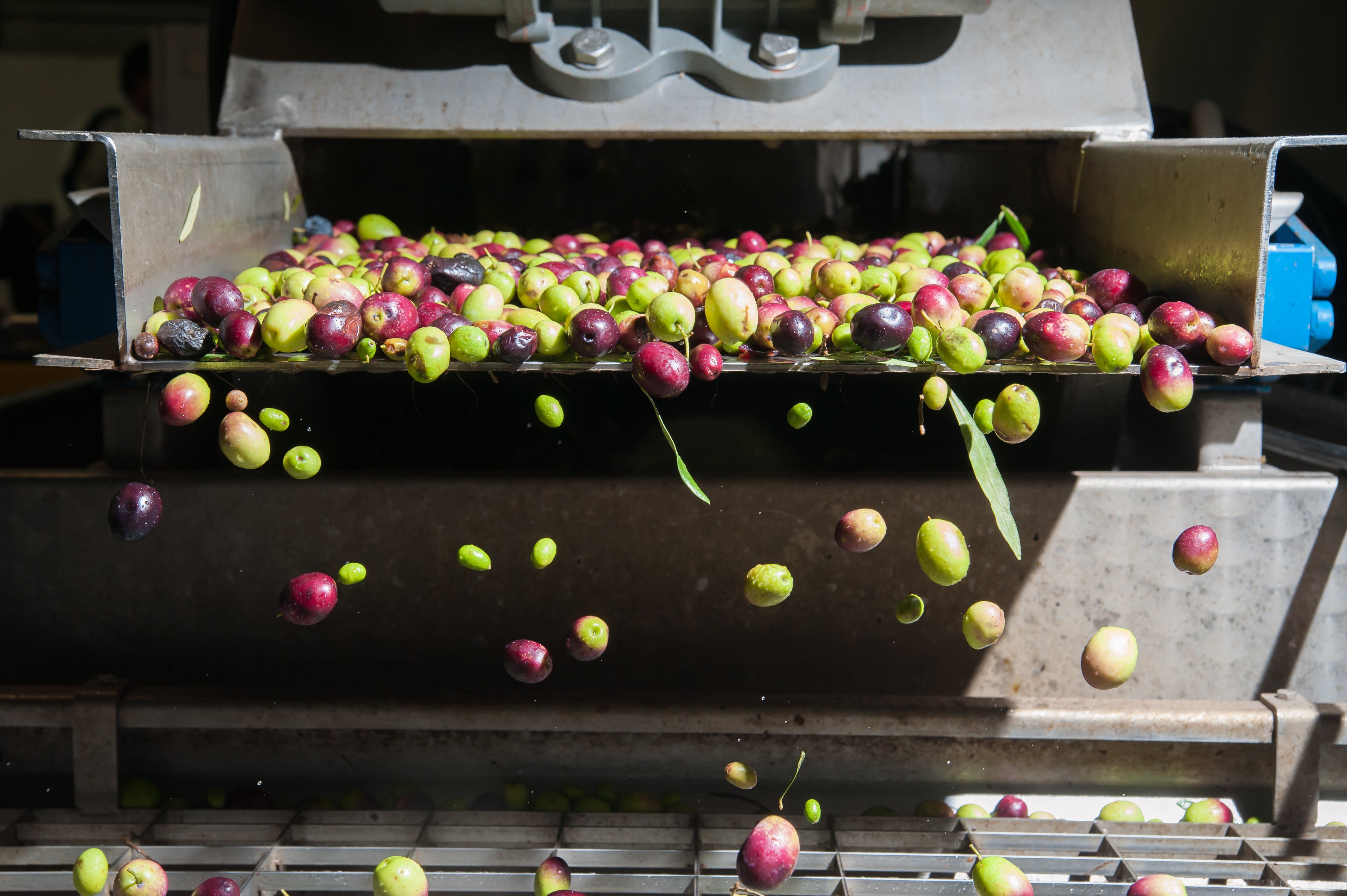
Free-fall optical food sorting presents a unique set of challenges. Products move at varying speeds, rotate unpredictably, and must be inspected in milliseconds - all while maintaining the highest standards of quality and food safety. At the same time, sorting systems are increasingly expected to detect not only surface-level color defects but also foreign materials and subsurface issues that are invisible to the human eye.
This is where prism-based multi-spectral line scan cameras offer a powerful advantage.
Challenge 1: Capturing Multispectral Data in Free-Fall Systems
Modern food sorting machines rely on multispectral imaging to make accurate grading and rejection decisions. Visible RGB data is essential for precise color grading, while Near-Infrared (NIR) or Short-Wave Infrared (SWIR) imaging enables detection of foreign objects such as stones, stems, or leaves as well as subsurface defects like bruising or rot.
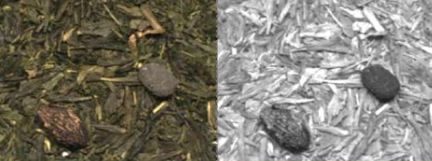 Foreign objects in tea leaves
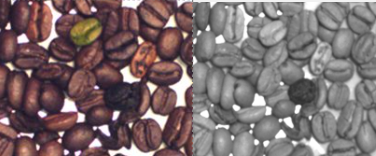 Imperfect beans in coffee production
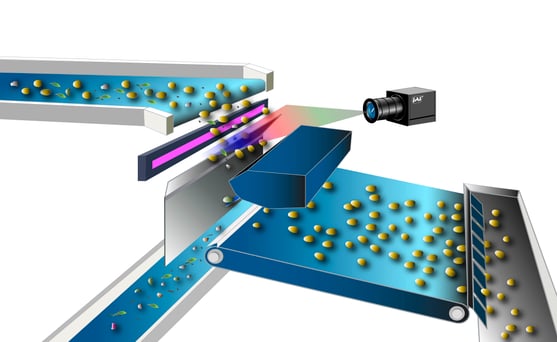
However, implementing multispectral inspection in a free-fall environment is far from trivial. Traditional approaches often require multiple cameras positioned at different angles, which increases system complexity, alignment effort, and cost. Synchronization issues between cameras can also lead to inconsistent inspection results.
The Solution: A Single Multi-Channel Prism-Based Camera
JAI’s Sweep+ Series prism-based line scan cameras address this challenge by combining multiple spectral channels into one perfectly aligned optical system.
Using a four-sensor prism design, the camera simultaneously captures:
- Red, Green, and Blue (RGB) images for accurate color grading
- NIR or SWIR images for foreign object detection and subsurface inspection
All image data is acquired at the same time, through the same optical axis, using a single camera. This eliminates the need for complex multi-camera setups while ensuring consistent and repeatable inspection results.
The Result: Complete Inspection Data from One Camera
By covering all required wavebands with a single multi-channel camera, food sorting machine builders can significantly simplify system design. Instead of managing multiple cameras, lenses, and alignment procedures, all inspection data is captured in one synchronized image stream.
This approach reduces mechanical complexity, shortens commissioning time, and improves long-term system stability, which is especially important in high-throughput industrial environments.
Challenge 2: Blurry Images and HALO Effects
Free-fall sorting systems also face another major hurdle: image quality.
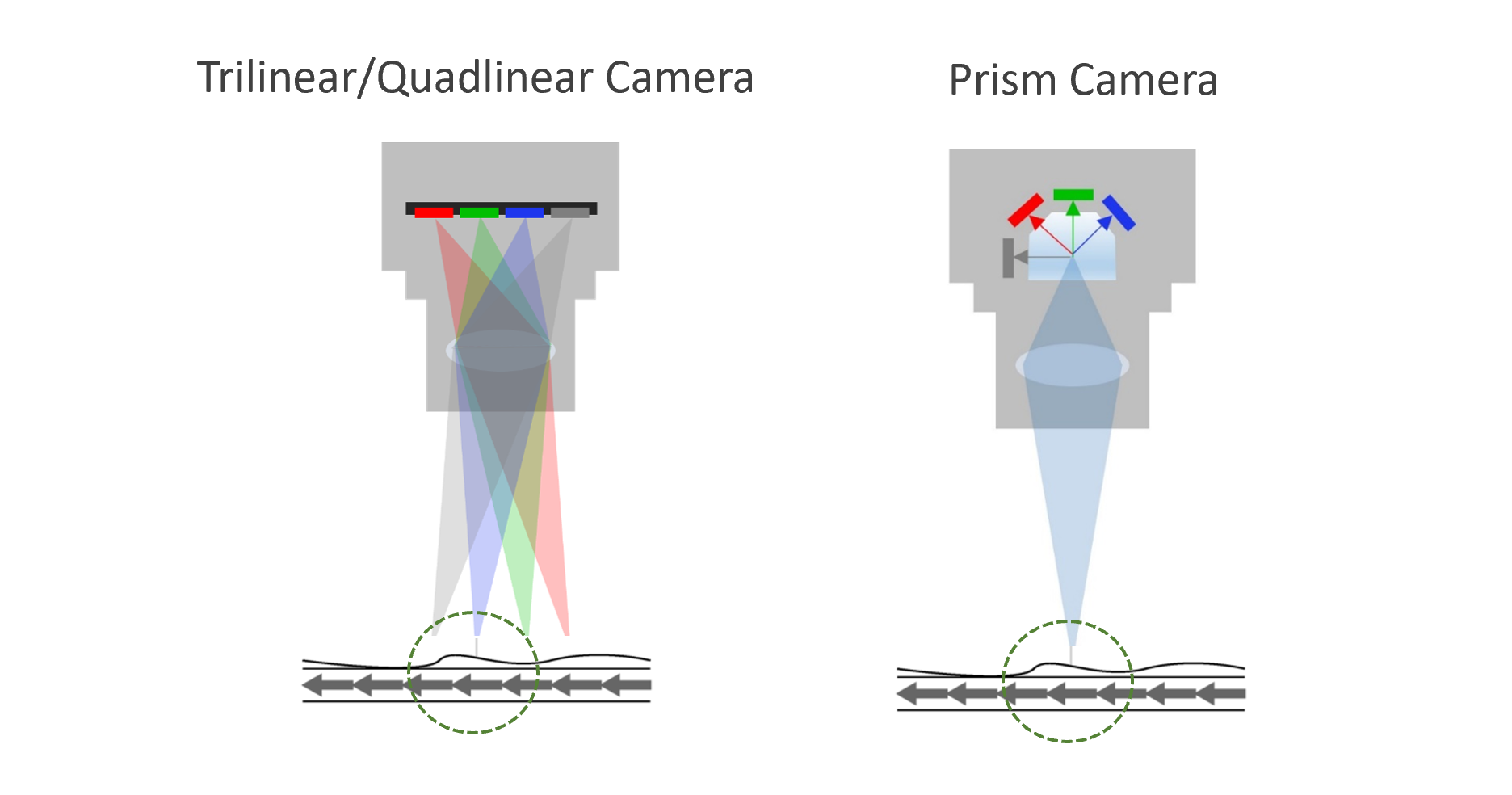
Products may spin, tumble, or fall at different speeds, making it difficult to capture sharp, blur-free images. In multi-camera or off-angle viewing setups, parallax differences between sensors can create HALO effects - color fringes or spatial misalignment that degrade image quality and reduce grading accuracy.
These artifacts are particularly problematic when inspecting round or unevenly shaped food items, or when precise spatial correlation between color and infrared data is required.
The Solution: A Single Optical Axis
JAI’s prism-based line scan cameras use a single optical axis to split incoming light into separate wavelengths. The prism directs red, green, blue, and infrared light to individual sensors that are perfectly pixel-aligned.
Because all spectral bands share the same optical plane:
- Parallax issues are eliminated
- HALO effects are removed
- Spatial alignment between channels is inherently maintained
Each pixel on each sensor always remains focused on the same physical point, even when objects rotate or fall at varying speeds.
The Result: Better Images, Better Sorting Decisions
The outcome is HALO-free images with superior color accuracy and spatial precision. This leads directly to more reliable grading, improved rejection accuracy, and more consistent product quality.
For food sorting applications, this means fewer false rejections, better yield, and greater confidence in automated decision-making, even under challenging free-fall conditions.
Visible and Infrared Inspection, Perfectly Synchronized
With a JAI Sweep+ Series multi-channel line scan camera, inspection systems can simultaneously and independently analyze:
- Visible RGB light (400–700 nm)
- NIR light (700–1000 nm) or
- SWIR light (approx. 800–1700 nm)
All data is captured in perfect temporal and spatial alignment, making it easier for downstream algorithms to combine spectral information and make accurate classification decisions in real time.
Designed for High-Performance Line Scan Applications
Prism-based line scan technology is particularly well suited for high-speed, continuous inspection tasks such as free-fall food sorting. The Sweep+ Series is designed to meet the demanding requirements of optical sorting machines, delivering reliable performance, high image quality, and simplified system integration.
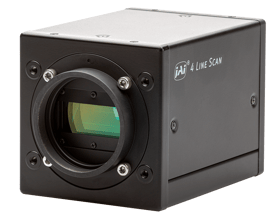
By combining multispectral imaging, precise pixel alignment, and single-camera architecture, prism line scan cameras offer a robust and future-ready solution for next-generation food sorting systems.