---
title: "SWIR Technology: Unlocking Invisible Information for Advanced Machine Vision Applications"
description: Discover how SWIR cameras enhance machine vision by detecting moisture, differentiating materials, and enabling advanced industrial inspection applications.
image: https://news.jai.com/hubfs/valentin-lacoste-26Q3fNyS3mg-unsplash.jpg
---
- [Products](https://www.jai.com/products)
- [Applications](https://www.jai.com/markets-applications)
- [Knowledge](https://www.jai.com/technology)
- [Blog](https://news.jai.com/blog)
- [Support & Software](https://www.jai.com/support-software)
- [Company](https://www.jai.com/company)
- [Contact](https://www.jai.com/contact/contact-jai)
[](https://cta-redirect.hubspot.com/cta/redirect/3919337/de912c88-f441-4cc7-a217-0079ed79e720)
Search...
- [](https://www.printfriendly.com)
- [Blog](https://news.jai.com/blog)
- [Support & Software](https://www.jai.com/support-software)
- [Login](https://www.jai.com/login)
- [Language English](https://www.jai.com/)
- [简体中文](https://news.jai.com/cn)
- [한국어](https://news.jai.com/ko)
- [Deutsch](https://news.jai.com/de)
[](https://www.jai.com/)
- [](https://www.jai.com/)
- [Products](https://www.jai.com/products)
- [Applications](https://www.jai.com/markets-applications)
- [Knowledge](https://www.jai.com/technology)
- [Blog](https://news.jai.com/blog)
- [Support & Software](https://www.jai.com/support-software)
- [Company](https://www.jai.com/company)
- [Contact](https://www.jai.com/contact/contact-jai)
- [Blog](https://news.jai.com/blog)
- [Support & Software](https://www.jai.com/support-software)
- [Login](https://www.jai.com/login)
- [Language English](https://www.jai.com/)
- [简体中文](https://news.jai.com/cn)
- [한국어](https://news.jai.com/ko)
- [Deutsch](https://news.jai.com/de)
- [](https://cta-redirect.hubspot.com/cta/redirect/3919337/de912c88-f441-4cc7-a217-0079ed79e720)
- [Home](https://www.jai.com/)
- [JAI Blog](https://news.jai.com/blog)
- SWIR Technology: Unlocking Invisible Information for Advanced Machine Vision Applications
# SWIR Technology: Unlocking Invisible Information for Advanced Machine Vision Applications
By [JAI](https://news.jai.com/blog/author/jai) | January 22, 2026
Short-wave infrared (SWIR) imaging has become an increasingly important technology in industrial machine vision. Operating in the wavelength range between approximately 900 nm and 1700 nm, SWIR cameras reveal material characteristics and details that are invisible to standard cameras. This unique capability makes SWIR imaging a powerful tool for inspection, sorting, and analysis across a wide range of industries.
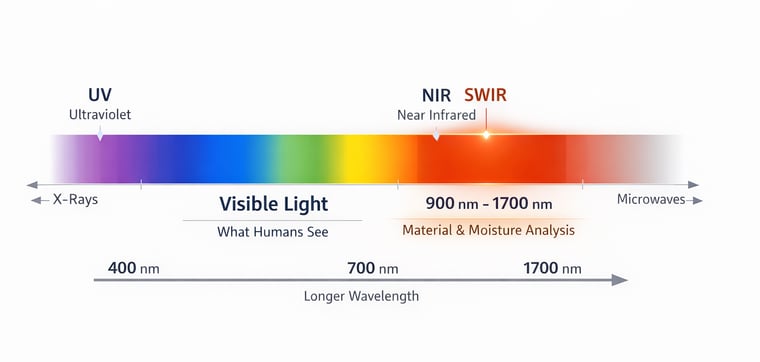
As manufacturing processes become more complex and quality requirements more stringent, SWIR cameras are enabling new inspection possibilities that were previously difficult or impossible to achieve with conventional imaging technologies.
### What Makes SWIR Imaging Different?
Different objects are transparent at different wavelengths. Meat is transparent to X-rays; bones are not. Water is transparent to visible light, but not to SWIR. Materials can behave very differently at different wavelengths. For example, water is transparent to visible light but absorbs SWIR, while silicon absorbs visible light but is transparent to SWIR. Items that look similar in visible light can be very different in SWIR.
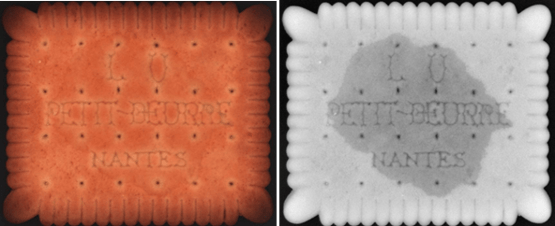
For example, plastics that appear to be the same color to the human eye can be easily differentiated in SWIR, and the absorption bands of water make moisture levels clearly visible -areas appear darker the more moisture they contain. These characteristics allow SWIR cameras to detect features and defects that are hidden from RGB or monochrome sensors.
### Key Advantages of SWIR Cameras
##### *1. Material Discrimination *
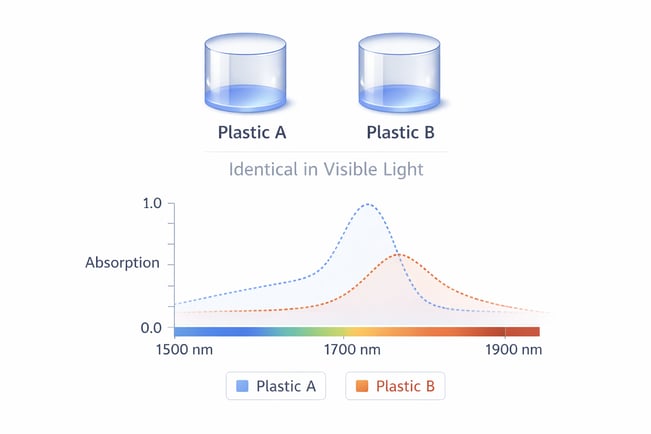
As SWIR interacts differently than visible light, it can be used to distinguish between objects. This makes SWIR cameras particularly effective for differentiating between similar-looking substances such as:
- Different types of plastics
- Organic vs. inorganic materials
- Good products vs. foreign objects
##### *2. Improved Imaging Through Obscurants *
SWIR light penetrates smoke, haze, dust, and some packaging materials better than visible light due to its longer wavelength. This makes SWIR imaging suitable for challenging environments where standard cameras struggle.
##### *3. Moisture and Contamination Detection *
Water strongly absorbs SWIR wavelengths, enabling precise detection of moisture, wet spots, and contamination. Adding a optical filter to the camera that matches the absorption lines of water can make it clearly detectable and measure moisture levels in objects. This is especially valuable in food processing and drying processes.
### Common SWIR Camera Technologies
Most industrial SWIR cameras use InGaAs (Indium Gallium Arsenide) sensors, as silicon is transparent to SWIR light, which offer:
- High sensitivity in the SWIR range
- Low noise
- High dynamic range
- Fast readout speeds
SWIR cameras are available in area scan and line scan formats, enabling their use in both static inspection and high-speed continuous processes such as web inspection or free-fall sorting.
Applications for SWIR Cameras
##### *Food Inspection and Sorting *
SWIR imaging plays a crucial role in food quality control by revealing characteristics that are invisible in visible light.
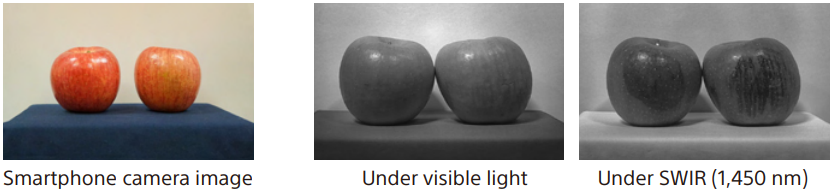
[*(Photo Source: Sony)*](https://www.sony-semicon.com/files/62/flyer_industry/IMX990_991_992_993_Flyer_en.pdf)
Typical food inspection applications include:
- Detecting foreign objects such as plastic, glass, or stones
- Identifying moisture variations in baked goods or produce
- Differentiating between good and defective products (e.g. mold detection)
- Sorting products based on ripeness or internal condition (e.g. internal browning in apples)
##### *Semiconductor and Electronics Inspection *
In semiconductor manufacturing, SWIR cameras are used to inspect through silicon that is partially transparent in this range.
Applications include:
- Detection of subsurface defects in wafers
- Alignment and bonding inspection
- Solar cell inspection
SWIR wavelengths allow inspection through silicon, adhesives, and some encapsulation layers, making them valuable for advanced electronics production.
##### *Recycling and Material Sorting *
Material identification is another strong use case for SWIR imaging.
SWIR cameras enable:
- Sorting of plastics by polymer type
- Detection of contaminants in recycling streams
By improving sorting accuracy, SWIR-based systems help increase material recovery rates and improve sustainability.
##### *Pharmaceutical and Chemical Inspection *
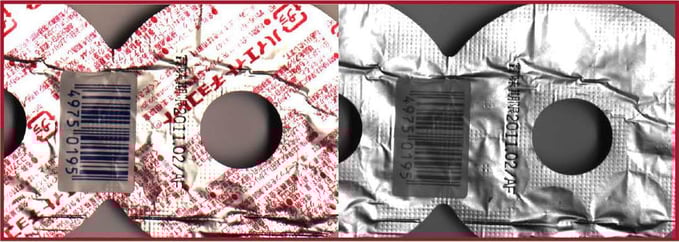
In pharmaceutical production, SWIR cameras support:
- Tablet coating inspection
- Detection of contamination or inconsistencies
- Verification of correct packaging and fill levels
- Identification of moisture-related defects
SWIR imaging provides non-contact, real-time inspection that supports strict regulatory and quality requirements.
##### *Web, Film and Coating Inspection*
In continuous production processes such as paper, film, or textile manufacturing, SWIR line scan cameras are used to inspect:
- Coating uniformity
- Adhesive application
- Moisture distribution
- Foreign material inclusion
SWIR imaging provides consistent results at high speeds, even in demanding industrial environments.
### Choosing the Right SWIR Camera for Your Application
When selecting a SWIR camera, key considerations include:
- Wavelength range required for the target materials
- Sensor resolution and speed
- Cooled vs uncooled sensors
- Area scan vs. line scan configuration
- Integration with existing machine vision systems
- Environmental and industrial robustness
Working closely with a camera manufacturer experienced in industrial SWIR applications helps ensure optimal performance and long-term reliability.
### The Future of SWIR Imaging in Machine Vision
As sensor technology continues to evolve, SWIR cameras are becoming more accessible, higher in resolution, and easier to integrate into industrial systems. At the same time, advances in SWIR illumination - particularly more powerful, stable, and cost-effective LED light sources - are improving image quality and enabling more reliable inspection in production environments. Improvements in optics and data processing are further expanding the range of applications where SWIR imaging delivers measurable value.
In parallel, new sensor technologies such as organic photoconductive sensors, colloidal quantum dot (CQD) sensors, and modified CMOS-based SWIR sensors are broadening the technological landscape. These developments promise lower prices, extended wavelength coverage, and more scalable manufacturing approaches, accelerating adoption across industries.
From food safety and sustainability to semiconductor manufacturing, advanced material inspection, and recycling, SWIR cameras are transforming how manufacturers see and understand their products.
### Conclusion
SWIR cameras open a new dimension in machine vision by revealing material properties that can't be detected by conventional imaging. Their ability to detect moisture, differentiate materials, and inspect beneath the surface makes them indispensable in many modern industrial applications.
As inspection challenges grow more complex, SWIR imaging provides manufacturers with another valuable tool to improve quality, efficiency, and process control, making it a key technology in the future of industrial vision systems.
**Topics:**
- [APPLICATIONS](https://news.jai.com/blog/tag/applications)
## Related articles
[AREA SCAN CAMERAS](https://news.jai.com/blog/tag/area-scan-cameras)
June 9, 2026 | By [JAI](https://news.jai.com/blog/author/jai) | **3 min read**
### Improving Steel Coil Inspection and Code Recognition
[Read more](https://news.jai.com/blog/improving-steel-coil-inspection-and-code-recognition)
[APPLICATIONS](https://news.jai.com/blog/tag/applications)
February 2, 2026 | By [JAI](https://news.jai.com/blog/author/jai) | **3 min read**
### Improving food safety and quality in fruit sorting and grading with SWIR Imaging
[Read more](https://news.jai.com/blog/improving-food-safety-and-quality-in-fruit-sorting-and-grading-with-swir-imaging)
[APPLICATIONS](https://news.jai.com/blog/tag/applications)
January 29, 2026 | By [JAI](https://news.jai.com/blog/author/jai) | **3 min read**
### Seeing Beyond the Surface: How SWIR Inspection Supports Semiconductor Manufacturing
[Read more](https://news.jai.com/blog/seeing-beyond-the-surface-how-swir-inspection-supports-semiconductor-manufacturing)
- [Products](https://www.jai.com/products)
- [Camera Selection Guide](https://www.jai.com/products/camera-selection-guide)
- [Product Series](https://www.jai.com/products/product-lines)
- [Area Scan Cameras](https://www.jai.com/products/area-scan-cameras)
- [Line Scan Cameras](https://www.jai.com/products/line-scan-cameras)
- [Lenses](https://www.jai.com/products/lenses)
- [Software Download](https://www.jai.com/support-software)
- [Traffic Camera & LED Flashes](https://www.jai.com/products/traffic-camera-subsystems-led-flashes)
- [Markets & Applications](https://www.jai.com/markets-applications)
- [Automotive](https://www.jai.com/markets-applications/automotive)
- [Electronics (PCB, Wafer etc.)](https://www.jai.com/markets-applications/electronics-pcb-lcd-wafer-etc)
- [Food and beverage](https://www.jai.com/markets-applications/food-and-beverage)
- [Outdoor and traffic](https://www.jai.com/markets-applications/outdoor-and-traffic)
- [Packaging and print](https://www.jai.com/markets-applications/packaging-and-print-inspection)
- [Pharmaceutical and Cosmetics](https://www.jai.com/markets-applications/pharmaceutical-and-cosmetics)
- [Sports and Entertainment](https://www.jai.com/markets-applications/sports-and-entertainment)
- [Web and Surface Inspection](https://www.jai.com/markets-applications/web-and-surface-inspection)
- [Medical & life sciences](https://www.jai.com/markets-applications/medical-and-life-sciences)
- [Government & defense](https://www.jai.com/markets-applications/aerospace-and-defense)
- [Knowledge](https://www.jai.com/technology)
- [Contact](https://www.jai.com/contact)
- [Contact JAI](https://www.jai.com/contact/contact-jai)
- [Office locations](https://www.jai.com/contact/office-locations)
- [Company](https://www.jai.com/company)
- [About JAI](https://www.jai.com/company/about-jai)
- [News](https://news.jai.com/)
#### Subscribe to our newsletter
Please sign up to JAI´s e-newsletter and get the latest news on products (area scan cameras, line scan cameras and traffic flashes), white papers, technologies and general news. All e-newsletters include an unsubscribe link. You may opt-out at any time. See our [privacy policy](https://www.jai.com/privacy-policy) for further information about processing of your personal data.
- [](https://www.linkedin.com/company/jai-as/)
- [](https://www.youtube.com/user/jaicameras)
- [](https://twitter.com/jaicameras)
- [](https://www.instagram.com/jaicameras/)
- [](https://www.facebook.com/JAI-Cameras-543205976126521/)
- [](https://blog.naver.com/jai-camera)

[](https://www.jai.com/)
- [Privacy policy](https://www.jai.com/privacy-policy)
- [Disclaimer](https://www.jai.com/disclaimer)
 