
Semiconductors are fundamental to modern technology, forming the core of countless everyday devices, from consumer electronics and electric vehicles to industrial automation and advanced computing systems. Behind each chip lies a highly controlled manufacturing process that spans several months and involves hundreds to thousands of individual steps, where every stage builds directly on the previous one, or, in some cases, multiple wafers with transistors and wires are bonded to each other to create a single integrated circuit.
Defects introduced early can propagate and intensify during later high-temperature and high-precision processes, making inspection a continuous requirement throughout the entire manufacturing flow. As structures become smaller and critical features extend below the surface, conventional visible-light inspection alone is no longer sufficient.
From Silicon to Wafer: Precision at Every Level
Before a single transistor is patterned, etched, or wired,every semiconductor device begins its life as ultra-pure silicon shaped with extraordinary precision. Wafer manufacturing starts with polycrystalline silicon heated to high temperatures until it melts. A carefully oriented silicon seed crystal is then brought into contact with the molten silicon and slowly pulled upward.
As it rises, the silicon solidifies around the seed, forming a single-crystal silicon rod, known as an ingot, with a perfectly aligned crystal structure.
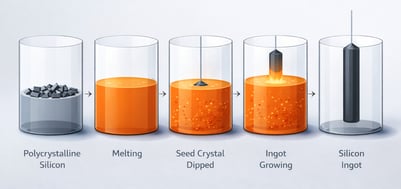 Polycrystalline silicon melting & ingot formation
The ingot is then transformed through a demanding sequence of slicing, lapping, edge rounding, heat treatment, polishing, and cleaning.
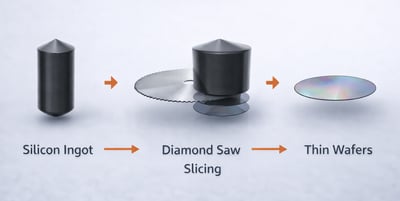 Ingot slicing & wafer production
The goal is uncompromising: silicon wafers with mirror-like surfaces and flatness controlled down to the sub-micron level. At this stage, even the smallest imperfection can propagate downstream, making inspection not just a quality step, but a fundamental requirement for modern semiconductor manufacturing.
Once the wafer is formed, it undergoes multiple process cycles (multiple times), including oxidation and thin-film deposition, photoresist coating, photolithography (exposure and development), etching, and ashing or cleaning. After front-end processing is completed, the wafer proceeds to the final manufacturing stages, which include final wafer inspection, wafer dicing, die attach, packaging, and final electrical testing.
-
Oxidation and Thin-Film Deposition
Functional layers such as silicon dioxide, silicon nitride, and various metals are formed on the wafer surface using processes including thermal oxidation and thin-film deposition. The uniformity of these layers is critical, as even minor thickness variations or localized defects can negatively impact downstream processes. -
Photoresist Coating
During photoresist coating, a light-sensitive resist is applied to the wafer surface in preparation for pattern transfer. Uniform resist thickness is critical, as variations directly impact exposure accuracy and pattern fidelity in later lithography steps. -
Photolithography (Exposure & Development)
Photolithography defines the critical patterns that form device structures on the wafer. These patterns ultimately encode the electrical functionality and operational behavior of the chip. Accurate alignment and complete development of the photoresist are essential, as even minor deviations can propagate into structural defects.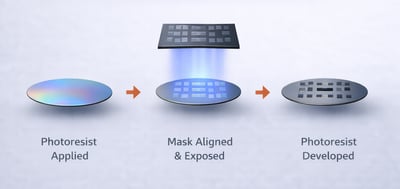 Wafer photolithography
 -
Etching (Wet & Dry)
Etching selectively removes material to form device structures. In this process, areas of the wafer not protected by the photoresist are precisely removed to transfer the intended pattern into the underlying layers. Incomplete etching or residual polymers can compromise electrical performance and lead to latent defects. -
Ashing/Cleaning
Ashing and cleaning remove remaining photoresist and process residues prior to subsequent processing. Residual contamination can interfere with later deposition or lithography steps, affecting yield and reliability. Once the surface is properly cleaned, new material layers are deposited and the patterning cycle repeats for the next layer. -
Final Wafer inspection (Post-Process)
After front-end processing, wafers undergo final inspection before dicing. Defects accumulated across multiple layers, as well as stress-induced or subsurface damage, must be identified to protect yield. -
Wafer Dicing
At this stage, the completed wafer, containing hundreds to several thousand individual chips, must be precisely separated into individual dies.Durin g wafer dicing, mechanical stress can introduce subsurface cracks and chipping along dicing lanes—defects that may not be visible at the surface but can later cause die failure.
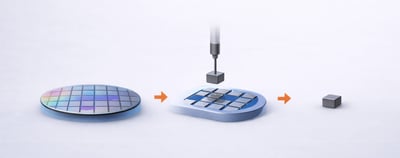
-
Die Attach, Packaging & Final Test
Packaging represents the final step of semiconductor fabrication, transforming the bare silicon die into a protected, electrically connected, and mechanically robust component ready for PCB integration. In this stages, individual dies are attached, packaged, and electrically tested. Mechanical damage introduced during handling or packaging can compromise long-term reliability.
SWIR imaging where surface inspection is not enough
The silicon, while opaque in the visible spectrum, becomes partially transparent at short-wave infrared (SWIR) wavelengths, allowing light to pass through the material. This makes it possible to inspect internal structures and defects beneath an apparently flawless surface, much like seeing cracks inside a glass window even when the surface appears smooth.Short-Wave Infrared (SWIR) imaging provides access to subsurface information and material contrast within silicon and related process layers, enabling earlier defect detection, improved process control, and more reliable manufacturing decisions throughout the semiconductor manufacturing flow.
Semiconductor manufacturing demands precision at every stage,as defects introduced early can propagate through the process, impacting yieldand reliability and potentially causing significant delivery delays, given thatproduction itself spans several months. As device structures shrink andinspection challenges move beyond the surface, SWIR imaging has become acritical enabler of effective process control, providing visibility intosubsurface features and material variations that cannot be addressed with visible-lightinspection alone.
Incoming Wafer Inspection
Inspection must begin before any value is added downstream. One of the very first, and most critical, inspection steps is the detection of hidden cracks and subsurface defects caused by uneven internal thermal stress during crystal growth or introduced later during slicing and mechanical processing.
.png?width=406&height=165&name=Wafer%20cracks%20(1).png) Wafer hidden crack inspection
Wafer hidden crack inspection
These microcracks are often invisible on the surface, yet they can expand during subsequent high-temperature steps, leading to wafer breakage, yield loss, or latent device failures. Starting the semiconductor process with a damaged waferis not just inefficient, it is costly and risky, as defects propagate and amplify through every following process step.
Inspection throught the manufacturing process
Integrated throughout the manufacturing flow, SWIR imaging enhances inspection capability during critical steps such as etching by detecting residual materials and incomplete removal of process layers. This early identification of defects helps prevent downstream issues and supports consistent, high-quality wafer production.
Back-end inspection for quality and reliability assurance
After front-end processing and before dicing, wafers undergo final inspection to assess accumulated defects across multiple layers. At this stage, SWIR imaging supports the detection of subsurface cracks, voids and structural defects or alignment related issues.
Furthermore, wafer dicing introduces mechanical stress that can generate cracks and chipping along dicing lanes—defects that may not beimmediately visible at the surface.
SWIR line scan cameras can be used to observe cutting paths and monitor along dicing lines, enabling early detection of crack initiation alog the edges.
Looking ahead, JAI will soon be able to support inspection needs across every stage of the semiconductor manufacturing process, with new products designed to meet the evolving requirements of advanced wafer inspection.