---
title: Improving food safety and quality in fruit sorting and grading with SWIR Imaging
description: Learn how SWIR cameras go beyond surface inspection to detect internal defects in fruits and vegetables, improving sorting accuracy and reducing food waste.
image: https://news.jai.com/hubfs/Blog-News%20images/News%20article%20featured%20images-770x445px/AdobeStock_657933608.jpeg
---
- [Products](https://www.jai.com/products)
- [Applications](https://www.jai.com/markets-applications)
- [Knowledge](https://www.jai.com/technology)
- [Blog](https://news.jai.com/blog)
- [Support & Software](https://www.jai.com/support-software)
- [Company](https://www.jai.com/company)
- [Contact](https://www.jai.com/contact/contact-jai)
[](https://cta-redirect.hubspot.com/cta/redirect/3919337/de912c88-f441-4cc7-a217-0079ed79e720)
Search...
- [](https://www.printfriendly.com)
- [Blog](https://news.jai.com/blog)
- [Support & Software](https://www.jai.com/support-software)
- [Login](https://www.jai.com/login)
- [Language English](https://www.jai.com/)
- [简体中文](https://news.jai.com/cn)
- [한국어](https://news.jai.com/ko)
- [Deutsch](https://news.jai.com/de)
[](https://www.jai.com/)
- [](https://www.jai.com/)
- [Products](https://www.jai.com/products)
- [Applications](https://www.jai.com/markets-applications)
- [Knowledge](https://www.jai.com/technology)
- [Blog](https://news.jai.com/blog)
- [Support & Software](https://www.jai.com/support-software)
- [Company](https://www.jai.com/company)
- [Contact](https://www.jai.com/contact/contact-jai)
- [Blog](https://news.jai.com/blog)
- [Support & Software](https://www.jai.com/support-software)
- [Login](https://www.jai.com/login)
- [Language English](https://www.jai.com/)
- [简体中文](https://news.jai.com/cn)
- [한국어](https://news.jai.com/ko)
- [Deutsch](https://news.jai.com/de)
- [](https://cta-redirect.hubspot.com/cta/redirect/3919337/de912c88-f441-4cc7-a217-0079ed79e720)
- [Home](https://www.jai.com/)
- [JAI Blog](https://news.jai.com/blog)
- Improving food safety and quality in fruit sorting and grading with SWIR Imaging
# Improving food safety and quality in fruit sorting and grading with SWIR Imaging
By [JAI](https://news.jai.com/blog/author/jai) | February 2, 2026
Fruit and vegetable sorting has evolved far beyond surface-level inspection. As food safety regulations tighten and quality expectations rise, producers need inspection technologies that can detect internal defects, subtle material differences, and hidden contamination at full production speed. For example, supermarket customers are unlikely to purchase visibly bruised fruit such as apples, even when the internal quality remains suitable for consumption. With accurate sorting in place, these apples can be redirected to alternative uses such as juices, purees, or processed foods rather than being discarded, maximizing product value for retailers while significantly reducing food waste across the supply chain.
This is where Short-Wave Infrared (SWIR) imaging has become a game-changer.
Unlike visible or standard monochrome imaging, SWIR exploits the characteristic absorption behavior of water, sugars, fats, and organic compounds in the 1000–1700 nm wavelength range. These spectral properties make SWIR uniquely suited for identifying defects, foreign materials, and quality attributes that are invisible to conventional vision systems.
Below, we explore how SWIR cameras enable robust inspection across several high value produce categories.
**Why SWIR for Food Sorting?**
SWIR imaging provides three critical advantages in food inspection:
- Material discrimination: Different organic and inorganic materials absorb SWIR light differently, even if they look identical in visible light.
- Subsurface visibility: SWIR can reveal defects beneath skins or shells, especially in water-rich products.
- Reliable inspection of dark or low-contrast objects: black, brown, or dark surfaces remain inspectable in SWIR.
These properties make SWIR particularly effective for grading, defect detection, and foreign material identification.
**Kiwi quality assessment**
**Detecting Blemishes, Soft Spots, and Puncture Damage**
Kiwi fruit presents a unique inspection challenge: a rough, fibrous exterior that can mask internal damage. Visible inspection often fails to distinguish between cosmetic surface variation and true quality defects.
**SWIR cameras enable:**
- Blemish detection
Internal bruising or tissue degradation alters moisture distribution within the fruit. SWIR wavelengths are highly sensitive to water absorption, making bruised regions appear with strong contrast.
- Soft spot identification
Softening caused by over-ripening or internal breakdown results in localized moisture changes. These areas are difficult to identify using conventional visible-light inspection but become clearly distinguishable in SWIR images.
- Puncture and impact damage
Small punctures or compression damage may not be obvious on the surface but lead to internal tissue disruption. SWIR reveals these hidden defects early, before decay progresses.
**Citrus quality evaluation (Lemons &Oranges)**
**Going Beyond Surface Color**
Citrus fruits are visually uniform, which makes detection particularly difficult using RGB or monochrome cameras alone. SWIR enables consistent detection of both surface and subsurface defects.
**Key Defects Explained**
- Blemishes
Surface discolorations caused by mechanical damage or environmental stress. SWIR helps distinguish superficial marks from deeper tissue damage.
- Calyx issues
The calyx is the green stem area. Missing, damaged, or decayed calyx regions can indicate reduced freshness or handling damage. SWIR improves contrast between healthy tissue and degraded areas.
- Rot
Internal decay often begins beneath the peel. SWIR can detect moisture and tissue breakdown before rot becomes externally visible.
- Stalk damage
Improper detachment can cause tearing and internal bruising around the stem area, which SWIR highlights clearly.
- Corrugations
Wrinkling or uneven peel texture caused by dehydration or physiological stress. SWIR helps quantify severity by analyzing moisture distribution.
- Mold
Early mold growth alters organic structure and moisture content. SWIR reveals mold-affected regions before visual spores appear.
- Oleocellosis (oil gland damage)
Caused by mechanical pressure rupturing oil glands in the peel, leading to darkened scars. SWIR enhances contrast between healthy and oil-damaged areas.
- Punctures
Small penetrations can trigger rapid decay. SWIR detects internal damage associated with these punctures, even if the surface opening is minimal.
**Dried Fruit quality control**
**Foreign Material Detection and Quality Assurance**
Dried fruits present a different challenge: low moisture content and highly variable shapes and textures. Traditional visible inspection struggles to reliably detect dense contaminants.
**SWIR excels at:**
- Foreign material detection
Dense inorganic contaminants such as:
- Rocks
- Glass
- Metal fragments
- Skin damage and structural defects
Tears, splits, or excessive dehydration alter internal structure, which SWIR highlights through contrast changes.
- Mold detection
Mold growth changes both chemical composition and moisture content. SWIR enables early detection, even on dark dried fruits like raisins or figs.
These materials have distinctly different SWIR absorption characteristics compared to organic dried fruit, making them stand out clearly—even when similar in color.
**Nut quality sorting**
**From Foreign Materials to Aflatoxin Risk Reduction**
Nut quality sorting requires reliable differentiation between acceptable product and defects based on internal structure and material composition rather than surface appearance.
**Key SWIR Capabilities**
- Foreign material identification
SWIR reliably detects stones, shells, and other non-nut materials mixed into product streams.
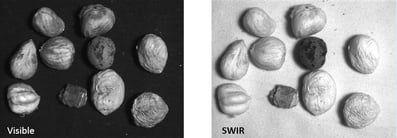
- In-shell nut detection
In-shell almonds or other nuts can pass unnoticed in visible inspection. SWIR differentiates shell material from kernel tissue with high reliability.
- Insect damage
Internal infestation alters fat and moisture distribution, producing clear contrast in SWIR images.
- Rotten and split nuts
Internal decay or structural fractures change absorption characteristics, making defective nuts easy to isolate.
**Aflatoxin (Risk Screening)**
Aflatoxin is a toxic compound produced by certain fungi (notably *Aspergillus* species) that can grow on nuts under improper storage conditions. It is:
- Highly carcinogenic
- Strictly regulated worldwide
- Often associated with internal mold growth rather than visible surface signs
While SWIR does not chemically “measure” aflatoxin, it is highly effective at detecting mold-damaged and structurally compromised nuts, which are strongly correlated with aflatoxin risk.
**The Role of SWIR Imaging in Food Inspection**
Across fresh produce, dried fruits, and nuts, SWIR imaging consistently delivers what conventional vision systems cannot: reliable material differentiation, subsurface defect detection, and robust foreign material identification.
As production speeds increase and quality standards tighten, SWIR cameras are no longer a niche technology, they are becoming an essential component of advanced food sorting and grading systems.
By seeing beyond surface appearance, SWIR enables producers to make better decisions, reduce waste, and deliver safer, higher-quality food to the market.
---
JAI will soon be able to provide even more dedicated solutions designed specifically for the demands of fruit and vegetable sorting and grading. These solutions will leverage SWIR imaging to address real-world inspection challenges across fresh produce, dried fruits, and nuts, enabling reliable detection of defects, contaminants, and quality attributes.
**Topics:**
- [APPLICATIONS](https://news.jai.com/blog/tag/applications)
## Related articles
[LINE SCAN CAMERAS](https://news.jai.com/blog/tag/line-scan-cameras)
July 30, 2026 | By [JAI](https://news.jai.com/blog/author/jai) | **3 min read**
### High-Speed, High-Accuracy Digital Pathology Scanning with Sweep Series
[Read more](https://news.jai.com/blog/high-speed-high-accuracy-digital-pathology-scanning-with-sweep-series)
[AREA SCAN CAMERAS](https://news.jai.com/blog/tag/area-scan-cameras)
June 9, 2026 | By [JAI](https://news.jai.com/blog/author/jai) | **3 min read**
### Improving Steel Coil Inspection and Code Recognition
[Read more](https://news.jai.com/blog/improving-steel-coil-inspection-and-code-recognition)
[APPLICATIONS](https://news.jai.com/blog/tag/applications)
January 29, 2026 | By [JAI](https://news.jai.com/blog/author/jai) | **3 min read**
### Seeing Beyond the Surface: How SWIR Inspection Supports Semiconductor Manufacturing
[Read more](https://news.jai.com/blog/seeing-beyond-the-surface-how-swir-inspection-supports-semiconductor-manufacturing)
- [Products](https://www.jai.com/products)
- [Camera Selection Guide](https://www.jai.com/products/camera-selection-guide)
- [Product Series](https://www.jai.com/products/product-lines)
- [Area Scan Cameras](https://www.jai.com/products/area-scan-cameras)
- [Line Scan Cameras](https://www.jai.com/products/line-scan-cameras)
- [Lenses](https://www.jai.com/products/lenses)
- [Software Download](https://www.jai.com/support-software)
- [Traffic Camera & LED Flashes](https://www.jai.com/products/traffic-camera-subsystems-led-flashes)
- [Markets & Applications](https://www.jai.com/markets-applications)
- [Automotive](https://www.jai.com/markets-applications/automotive)
- [Electronics (PCB, Wafer etc.)](https://www.jai.com/markets-applications/electronics-pcb-lcd-wafer-etc)
- [Food and beverage](https://www.jai.com/markets-applications/food-and-beverage)
- [Outdoor and traffic](https://www.jai.com/markets-applications/outdoor-and-traffic)
- [Packaging and print](https://www.jai.com/markets-applications/packaging-and-print-inspection)
- [Pharmaceutical and Cosmetics](https://www.jai.com/markets-applications/pharmaceutical-and-cosmetics)
- [Sports and Entertainment](https://www.jai.com/markets-applications/sports-and-entertainment)
- [Web and Surface Inspection](https://www.jai.com/markets-applications/web-and-surface-inspection)
- [Medical & life sciences](https://www.jai.com/markets-applications/medical-and-life-sciences)
- [Government & defense](https://www.jai.com/markets-applications/aerospace-and-defense)
- [Knowledge](https://www.jai.com/technology)
- [Contact](https://www.jai.com/contact)
- [Contact JAI](https://www.jai.com/contact/contact-jai)
- [Office locations](https://www.jai.com/contact/office-locations)
- [Company](https://www.jai.com/company)
- [About JAI](https://www.jai.com/company/about-jai)
- [News](https://news.jai.com/)
#### Subscribe to our newsletter
Please sign up to JAI´s e-newsletter and get the latest news on products (area scan cameras, line scan cameras and traffic flashes), white papers, technologies and general news. All e-newsletters include an unsubscribe link. You may opt-out at any time. See our [privacy policy](https://www.jai.com/privacy-policy) for further information about processing of your personal data.
- [](https://www.linkedin.com/company/jai-as/)
- [](https://www.youtube.com/user/jaicameras)
- [](https://twitter.com/jaicameras)
- [](https://www.instagram.com/jaicameras/)
- [](https://www.facebook.com/JAI-Cameras-543205976126521/)
- [](https://blog.naver.com/jai-camera)

[](https://www.jai.com/)
- [Privacy policy](https://www.jai.com/privacy-policy)
- [Disclaimer](https://www.jai.com/disclaimer)
 
```json
{
"@context" : "https://schema.org",
"@type" : "VideoObject",
"contentUrl" : "https://3919337.fs1.hubspotusercontent-na1.net/hubfs/3919337/video_assets/206341667889/inherited/web_optimized.mp4",
"dateModified" : "2026-01-30T09:58:33.540Z",
"duration" : "PT16S",
"height" : 1080,
"name" : "Fruit Sorting and Grading_Kiwi",
"thumbnailUrl" : "https://api-na1.hubspot.com/filemanager/api/v3/files/thumbnail-redirect/206341667889?portalId=3919337&size=medium",
"uploadDate" : "2026-01-30T09:57:58.366Z",
"width" : 1920
}
```
```json
{
"@context" : "https://schema.org",
"@type" : "VideoObject",
"contentUrl" : "https://3919337.fs1.hubspotusercontent-na1.net/hubfs/3919337/video_assets/206341667892/inherited/web_optimized.mp4",
"dateModified" : "2026-01-30T10:00:11.295Z",
"duration" : "PT16S",
"height" : 1080,
"name" : "Fruit Sorting and Grading_Oranges",
"thumbnailUrl" : "https://api-na1.hubspot.com/filemanager/api/v3/files/thumbnail-redirect/206341667892?portalId=3919337&size=medium",
"uploadDate" : "2026-01-30T09:57:58.669Z",
"width" : 1920
}
```
```json
{
"@context" : "https://schema.org",
"@type" : "VideoObject",
"contentUrl" : "https://3919337.fs1.hubspotusercontent-na1.net/hubfs/3919337/video_assets/206382369363/inherited/web_optimized.mp4",
"dateModified" : "2026-01-30T10:01:15.473Z",
"duration" : "PT19S",
"height" : 1080,
"name" : "Fruit Sorting and Grading_Almonds",
"thumbnailUrl" : "https://api-na1.hubspot.com/filemanager/api/v3/files/thumbnail-redirect/206382369363?portalId=3919337&size=medium",
"uploadDate" : "2026-01-30T09:57:59.689Z",
"width" : 1920
}
```